How the “Deep State” May Influence Regime Change: Power, Intelligence, and Political Strategy
Introduction
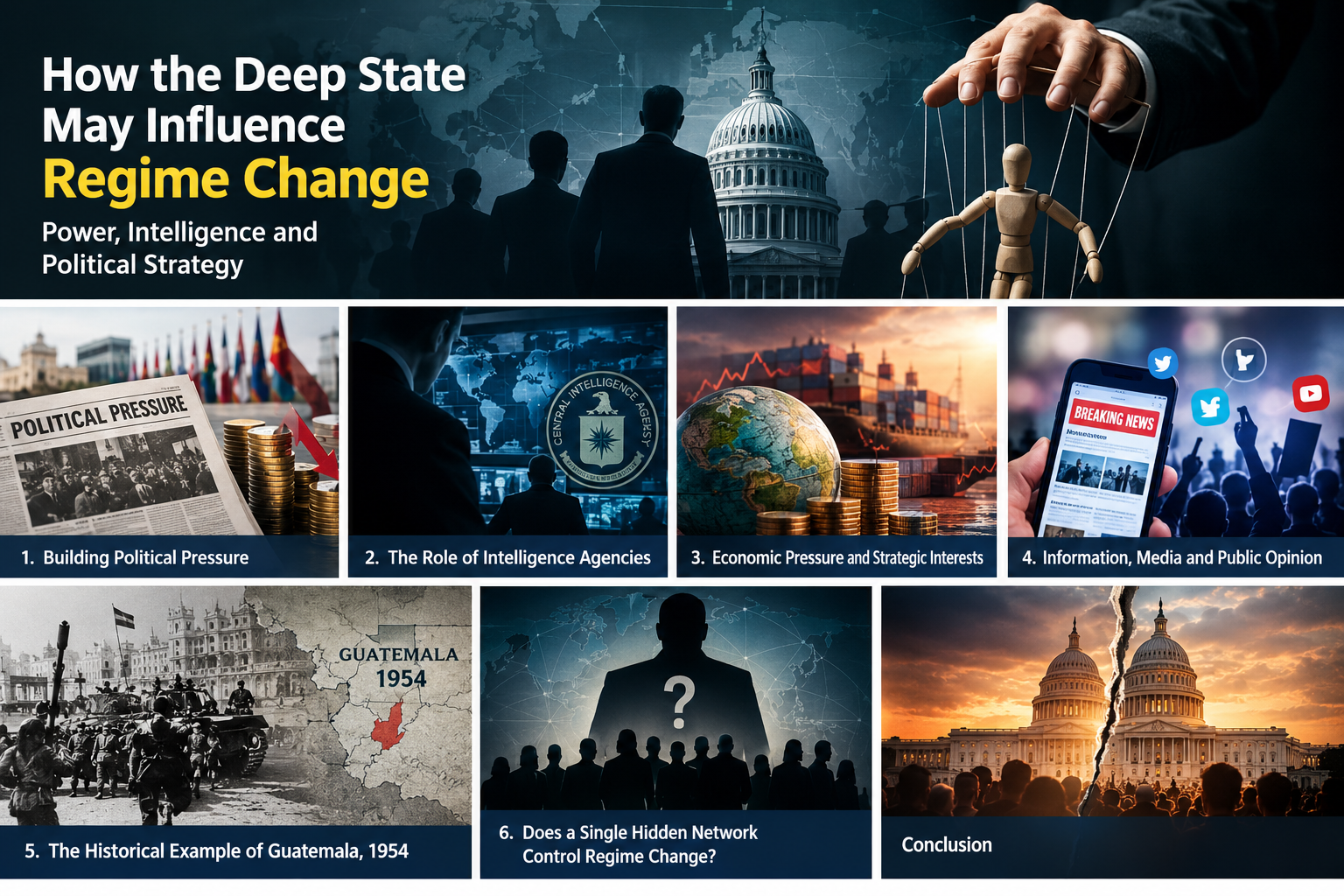
The term deep state is often used to describe powerful networks within government institutions, intelligence agencies, military establishments, and other influential organizations that may operate beyond the direct control of elected leaders. The concept has become a major subject of political debate, particularly when governments face internal instability or international pressure.
But how can powerful institutions influence the rise or fall of a government? History provides documented examples of covert intervention, political pressure, and intelligence operations. Understanding these events requires distinguishing verified historical evidence from speculation about secret organizations controlling world politics.
1. Building Political Pressure
One way powerful domestic or foreign actors can influence a government is by increasing political pressure on its leadership. Diplomatic isolation, economic restrictions, public criticism, and the withdrawal of international support can weaken a government's position.
When a government is already facing corruption allegations, economic difficulties, or widespread dissatisfaction, these pressures may intensify existing political divisions.
However, political pressure does not automatically mean that a secret organization is directing events. Governments can also lose public support because of their own policies, economic failures, or internal conflicts.
2. The Role of Intelligence Agencies
Intelligence agencies gather information about political leaders, military institutions, opposition movements, and foreign governments. In some historical cases, intelligence organizations have also conducted covert operations intended to influence political outcomes.
A well-documented example is Iran in 1953. Declassified American government documents describe the CIA's involvement in a covert operation intended to remove Prime Minister Mohammad Mossadegh and strengthen the position of the Shah. The operation involved political coordination and efforts to influence the country's political environment.
This case demonstrates that covert efforts to change a government are not merely fictional ideas. They have occurred historically and are documented in official records.
Source: U.S. Department of State, Foreign Relations of the United States, 1952–1954: Iran.
3. Economic Pressure and Strategic Interests
Economic interests can also influence international political decisions. Countries may use sanctions, restrictions on financial transactions, trade policies, or changes in foreign assistance to pressure another government.
These measures may be justified by national security concerns, human rights issues, or disputes over international policy. Critics may argue that they also serve strategic or economic interests.
Nevertheless, economic pressure alone rarely explains every political transition. Domestic institutions, public opinion, leadership decisions, and the strength of opposition movements also matter.
4. Information, Media, and Public Opinion
Public opinion can significantly affect a government's stability. News organizations, political campaigns, social media platforms, and advocacy groups influence how citizens understand political events.
Information campaigns can highlight genuine government failures, promote particular political narratives, or circulate misleading claims. In some historical covert operations, psychological warfare and propaganda were explicitly used to influence political outcomes.
For this reason, readers should examine the original source of a claim, identify who benefits from its circulation, and compare reporting from independent outlets. The existence of propaganda does not mean that every unfavorable report about a government is part of a coordinated conspiracy.
5. The Historical Example of Guatemala, 1954
Guatemala provides another documented example of foreign involvement in regime change. Official historical records describe a CIA operation against the government of President Jacobo Árbenz.
The operation included diplomatic and economic pressure, psychological warfare, efforts to encourage defections, and paramilitary activity. These actions contributed to the political crisis that ended with Árbenz leaving office in 1954.
The case illustrates how foreign intervention can interact with domestic political divisions. It also demonstrates why historical claims about covert operations should be assessed using declassified documents and credible scholarship rather than assumptions alone.
Source: U.S. Department of State, Foreign Relations of the United States, 1952–1954: Guatemala.
6. Does a Single Hidden Network Control Regime Change?
The idea that one unified, secret organization plans every major political transition is a much broader claim than the historical evidence supports.
The expression deep state has different meanings in different political contexts. It may refer to entrenched security institutions, informal power networks, bureaucratic resistance, or an alleged conspiracy operating behind elected governments.
Researchers disagree about how useful the concept is, and the term is sometimes used without clear evidence. Political developments that appear coordinated may instead result from competing institutions, local opposition movements, international rivalries, or several independent groups pursuing different objectives.
A careful investigation must therefore ask specific questions: Who took the action? What documents establish their involvement? What were their stated objectives? What independent evidence supports the claim?
Conclusion
Regime change can result from a complicated combination of domestic dissatisfaction, economic pressure, political opposition, military decisions, and foreign intervention. Historical cases in Iran and Guatemala demonstrate that covert operations to influence or remove governments have occurred.
At the same time, these documented events do not prove that every political crisis is orchestrated by a single hidden power. The most reliable way to understand political change is to examine verifiable evidence, compare competing explanations, and distinguish documented operations from unproven allegations.
Ultimately, understanding the relationship between intelligence agencies, political institutions, and international power requires historical research, critical thinking, and transparency—not simply accepting or dismissing every claim about the deep state.